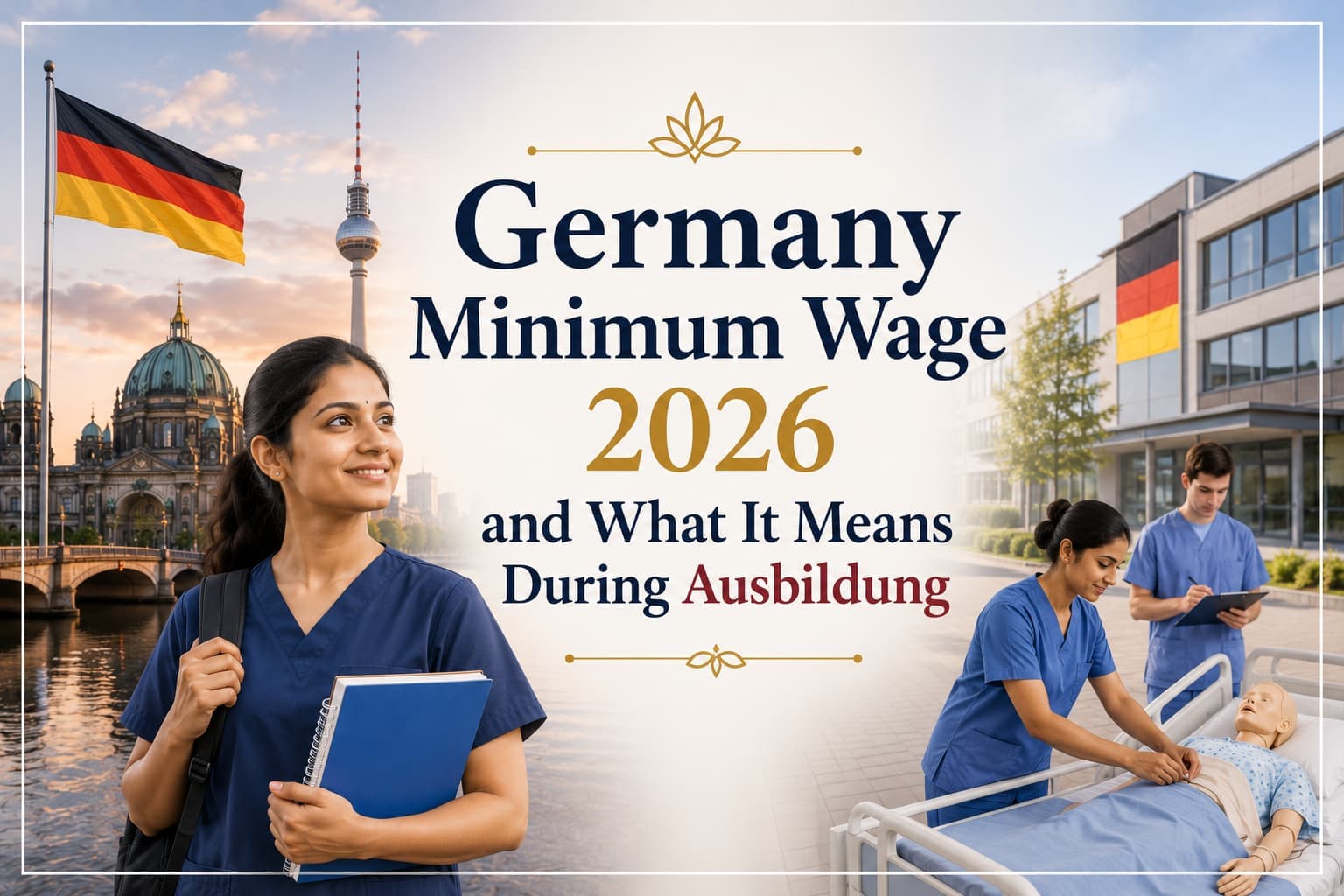
Germany Minimum Wage 2026 and What It Means During Ausbildung
Fast Facts: Life in Germany
5 Years
To Permanent Residency
€250
Child Support / Kid
"Many Indian nurses ask whether Germany's minimum wage applies during Ausbildung. The short answer is: not directly. Ausbildung trainees are covered by a different legal framework — and for nursing specifically, collective agreements set pay well above any legal minimum.
Quick Answer
Understanding the difference between Germany's minimum wage and what you actually earn during nursing Ausbildung is important for realistic financial planning. The two figures are governed by entirely different laws and apply to different types of contracts.
What Is Germany's Minimum Wage in 2026?
Germany's general minimum wage (Mindestlohn) is a statutory hourly rate that applies to all standard employment contracts. It is reviewed annually by the German Minimum Wage Commission and has been rising steadily — reaching €12.82/hour as of January 2025, with further adjustments expected for 2026.
At 40 working hours per week, this translates to roughly €2,222/month gross for a full-time employee.
However, this rate applies to employees — not trainees on Ausbildung contracts.
Does Minimum Wage Apply During Nursing Ausbildung?
No. Ausbildung is governed by a separate legal framework under the Vocational Training Act (Berufsbildungsgesetz). Trainees on Ausbildung contracts are covered by the Mindestausbildungsvergütung — a minimum training allowance that is set separately from the general minimum wage.
The practical difference:
| Contract Type | Applicable Law | Floor Rate |
|---|---|---|
| Standard employment | Mindestlohngesetz (minimum wage law) | €12.82/hour (2025) |
| Ausbildung training contract | Berufsbildungsgesetz (vocational training law) | Minimum training allowance (lower than Mindestlohn) |
For nursing Ausbildung specifically, this distinction is largely academic — because nursing is governed by collective bargaining agreements (TVöD for public hospitals, equivalent agreements for private and charitable employers) that set training pay well above the legal minimum.
What Do Nursing Ausbildung Trainees Actually Earn?
Nursing Ausbildung pay is set by collective agreements, not minimum wage law. The result is significantly higher than the minimum training allowance floor:
| Training Year | Monthly Gross (Collective Agreement) |
|---|---|
| Year 1 | €1,200–€1,340 |
| Year 2 | €1,250–€1,402 |
| Year 3 | €1,300–€1,503 |
Exact figures vary slightly depending on whether your training hospital is under TVöD (public sector) or a private/charitable employer agreement. Public sector hospitals tend to follow TVöD, which is one of the more consistently higher-paying frameworks.
For a full breakdown of what Ausbildung pay looks like month by month and how it compares to post-qualification nurse salaries, see our Ausbildung nurse salary guide.
What Changes After Ausbildung?
Once you complete Ausbildung and register as a qualified nurse, you move from a training contract to a standard employment contract. At that point, the general minimum wage applies — but is immediately irrelevant, since qualified nurses in Germany start at €2,800–€3,800/month gross under the same collective agreements, far above the minimum wage floor.
The salary jump from Year 3 Ausbildung trainee to qualified nurse is substantial:
| Status | Approximate Monthly Gross |
|---|---|
| Ausbildung Year 3 | €1,300–€1,503 |
| Qualified Nurse (Year 1) | €2,800–€3,000 |
This is the defining characteristic of the Ausbildung path — three years of lower training pay followed by a significant step up. For a comparison of whether Ausbildung or direct recognition makes more financial sense over time, see our Ausbildung vs direct nurse salary comparison.
Can I Do Part-Time Work Alongside Ausbildung?
Some Ausbildung contracts allow limited additional employment — but this depends on your training contract and employer. If part-time work is permitted, Germany's general minimum wage does apply to those additional working hours, since you'd be on a separate employment contract for that role.
Calculate Your Net Income and Savings
Use the Taldo Germany Salary Calculator to estimate your take-home pay — both at Ausbildung training salary and at the full qualified nurse salary you'll receive after completing your three years.
Ready to Take the First Step?
Chat with a Taldo Senior Career Counsellor for free to understand whether Ausbildung or direct Anerkennung is the better financial path for your specific situation.
Q: Does Germany's minimum wage apply to nursing Ausbildung trainees?
No — Ausbildung trainees are covered by the Mindestausbildungsvergütung (minimum training allowance) under a separate law, not the general Mindestlohn. For nursing specifically, collective bargaining agreements (primarily TVöD) govern training pay and set it well above the minimum training allowance floor — resulting in €1,200–€1,503/month depending on year and employer. Chat with a Taldo counsellor for personalised guidance on Ausbildung pay.
Q: Is €1,200–€1,500/month enough to live on during Ausbildung in Germany?
It's tight but manageable in most German cities outside Munich and Frankfurt. Average monthly living costs for a single person (rent, food, transport, insurance) run €900–€1,300 depending on city and lifestyle. Many Ausbildung hospitals offer accommodation support or subsidised canteen meals, which reduces costs significantly in the first year. Planning finances carefully before arrival is strongly advisable. Chat with a Taldo counsellor for a realistic financial breakdown.
Q: How much will I earn once I finish nursing Ausbildung?
On completing Ausbildung and registering as a qualified nurse, your gross salary jumps to €2,800–€3,000/month in an entry-level position — roughly double your Year 3 training pay. This increase applies from your first month as a qualified nurse, not gradually. From there, salary increases with experience, specialisation, and progression into senior or management roles. Chat with a Taldo counsellor to plan your career path after Ausbildung.