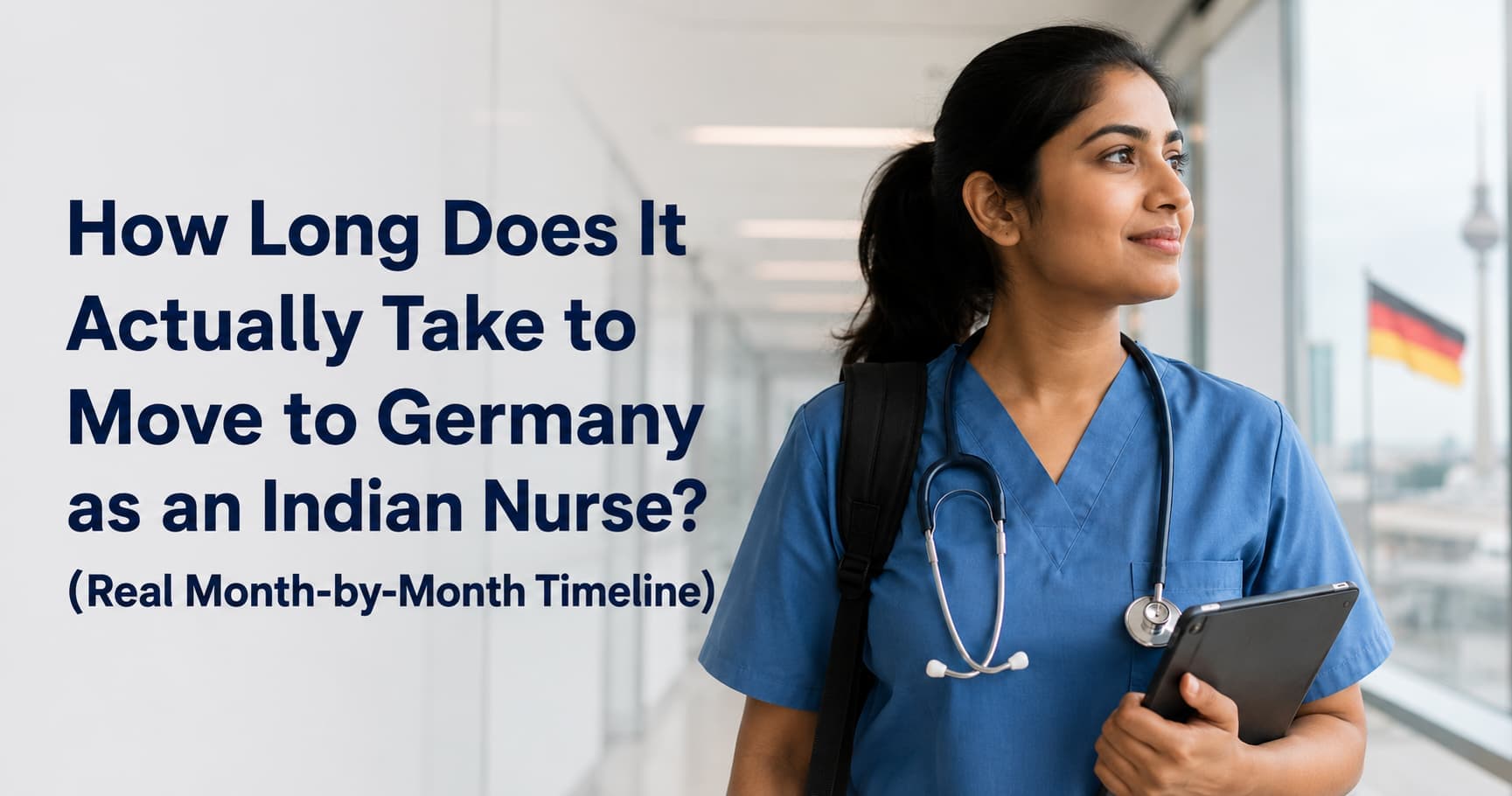
How Long Does It Actually Take to Move to Germany as an Indian Nurse? (Real Month-by-Month Timeline)
Fast Facts: Life in Germany
5 Years
To Permanent Residency
30 Days
Paid Annual Leave
"You have made the decision. Now you need to know what the next 18 months actually look like — not a vague "it takes time" answer, but the real sequence of steps, what runs in parallel, and where the delays typically happen. This is that guide.
Quick Answer
The 15-month figure gets quoted a lot, and it is achievable — but only if you start language study immediately, your documents are clean, and your recognition is processed quickly. For most nurses starting from zero German, 18 months is more realistic. This breakdown explains every phase so you can see exactly where you are and what to do next.
What Does the Month-by-Month Journey Actually Look Like?
The journey has five distinct phases that partially overlap. Understanding which phases run in parallel is what lets you compress the total timeline.
Phase 1: Language Study (Months 1 to 15)
This is the longest phase and the one that cannot be shortened by paying more or applying faster. German language proficiency at B2 is a federal requirement before you can begin the recognition process. Starting at zero, reaching B2 takes 12 to 15 months of consistent study — typically 2 to 3 hours per day across online classes and self-study.
The single most effective thing you can do to shorten your total timeline is to start language study immediately, before you have done anything else.
If you are already at A2 or B1 when you begin, your total timeline compresses significantly. Some nurses who enter with A2 reach B2 in 8 to 10 months.
Phase 2: Document Preparation (Months 1 to 6, parallel with language)
While you are studying German, start gathering your documents in the background. You do not need B2 to prepare your papers — this runs in parallel and costs you nothing in time if you start early.
Documents required for the recognition (Anerkennung) application:
- ✦Nursing degree certificate (original and certified copy)
- ✦Mark sheets / transcripts from your nursing college
- ✦Nursing Council registration certificate
- ✦Curriculum / syllabus from your nursing institution
- ✦Proof of any clinical experience post-qualification
- ✦Passport copy
All documents must be translated into German by a certified translator and, for most states, apostilled. Getting the apostille from your state government can take 4 to 8 weeks, so start this in Month 1 or 2.
Phase 3: Recognition Application (Months 12 to 16)
Once you pass your B2 exam, your Anerkennung application goes to the recognition authority of the German state where you intend to work. Many states now offer a 60-day fast-track review for internationally qualified nurses. Complex cases or missing documents can extend this to 4 to 6 months.
The recognition decision will be one of three outcomes:
| Outcome | What It Means | Next Step |
|---|---|---|
| Full recognition | Your qualification matches German standards | Apply for visa directly |
| Partial recognition | Gap in clinical hours identified | Anpassungslehrgang (bridging course) |
| Rejection | Significant gap, or documents incomplete | Reapply with additional evidence |
BSc nurses from recognised Indian institutions typically receive full recognition. GNM nurses typically receive partial recognition and must complete an Anpassungslehrgang of 3 to 6 months in a German hospital before receiving their full licence.
For a detailed explanation of what partial recognition means and how the bridging course works, read our guide to the Anerkennung process for Indian nurses.
Phase 4: Job Matching and Visa (Months 14 to 18)
Job matching with a German hospital begins once your recognition decision is known, or sometimes slightly before if your documents are strong. Taldo matches nurses with hospital partners based on specialisation, preferred state, and language level.
Once you have a signed job contract, you apply for the German Skilled Worker Visa at your local German consulate in India. Visa processing typically takes 6 to 12 weeks. The consulate appointment itself can take 3 to 6 weeks to schedule, so book early.
Documents for the visa application include:
- ✦Valid passport
- ✦Recognition decision letter (full or partial)
- ✦Job contract from a German hospital
- ✦B2 language certificate
- ✦Health insurance confirmation
- ✦Proof of accommodation in Germany (often arranged by the hospital)
For the complete visa document checklist and what to expect at the consulate appointment, read our Germany visa guide for Indian nurses.
Phase 5: Arrival and First Months (Months 15 to 24)
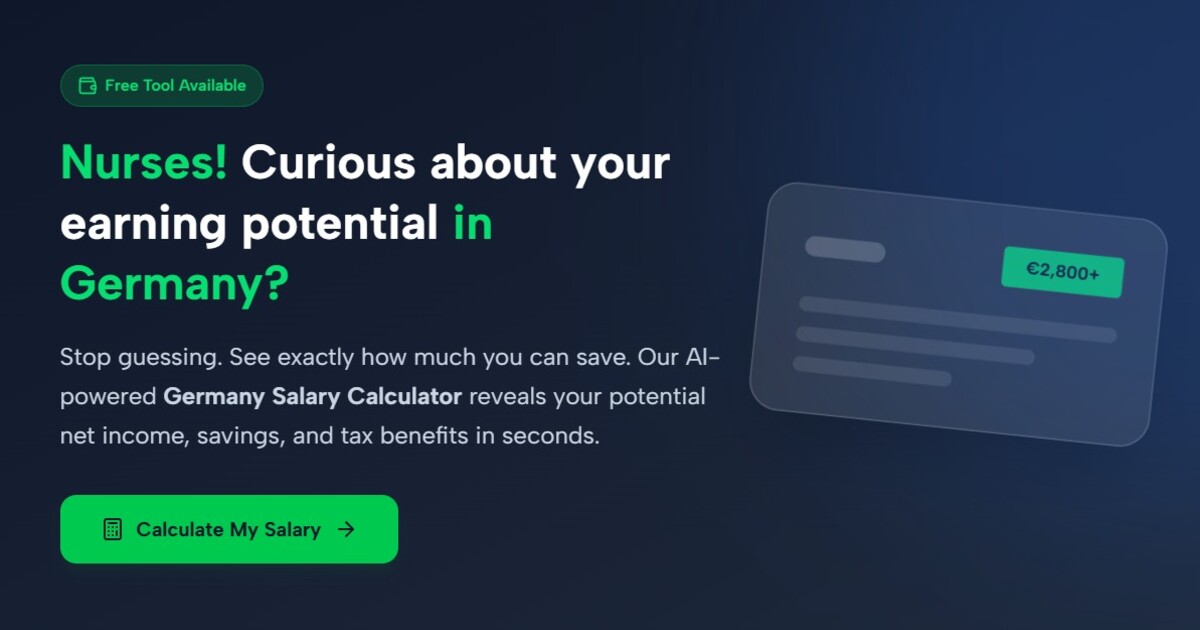
BSc nurses with full recognition begin working as registered nurses from their first day. Your contract starts, and you earn €2,800 to €3,800 gross per month (€1,700 to €1,900 net after taxes and social contributions).
GNM nurses with partial recognition begin the Anpassungslehrgang immediately on arrival. This is a paid hospital placement of 3 to 6 months, earning a training stipend of €1,400 to €1,800 per month. Once the bridging course is complete and the hospital confirms your competency, the recognition authority issues your full nursing licence and your regular contract begins.
Use the Taldo salary calculator to see your specific net take-home based on your expected state and seniority level.
Realistic Total Timelines at a Glance
| Profile | Expected Total Timeline |
|---|---|
| BSc nurse, starting at A2 German, fast recognition | 12 to 15 months |
| BSc nurse, starting at zero German, standard recognition | 16 to 18 months |
| GNM nurse, starting at zero German, partial recognition + bridging | 20 to 24 months |
The 15-month minimum is real but requires everything to go smoothly: language study started immediately, documents prepared in parallel, fast recognition decision, and no visa delays. Build in a buffer of 2 to 3 months when planning your finances and telling your current employer.
Q: Can I start working in Germany before my full recognition is complete?
In some states, nurses can be granted a provisional work permit (Berufserlaubnis) that allows them to work under supervision while the recognition process is ongoing. This is not available in every state and depends on your specific situation. If your partial recognition requires an Anpassungslehrgang, that placement is itself a supervised working arrangement, so you are employed and earning from day one in Germany.Q: What happens if my visa application is rejected?
Visa rejections are uncommon when all documents are in order and the recognition decision is positive. The most frequent causes are incomplete documentation, a job contract that does not meet the salary threshold, or a consulate backlog causing missed details. If rejected, you receive a written reason and can reapply with the corrected documents. Taldo reviews all visa documents before submission to reduce this risk.Q: Can my family travel to Germany with me, or do they need to wait?
Your family can apply for family reunification visas once you have a valid German residence permit and can demonstrate stable employment and adequate housing. Most nurses bring their family 12 to 18 months after arriving, once they have completed the Anpassungslehrgang, started their full contract, and secured permanent accommodation. Processing time for family reunification visas from India is currently 3 to 6 months.If you want to map your specific situation against this timeline, chat with a Taldo Senior Career Counsellor on WhatsApp — it is free, and they can give you a personalised month-by-month plan based on your current German level, qualification, and target state.