Anerkennung: What Indian Nurses Need to Know Before Moving to Germany
Fast Facts: Life in Germany
14 Mo
Paid Parental Leave
€250
Child Support / Kid
"GNM or B.Sc Nursing — does your Indian degree actually work in Germany? Short answer: yes. Here's the longer one.
Anerkennung is the single most important word in your Germany journey. Everything — your visa, your job offer, your ability to legally work as a nurse — depends on it. And yet most Indian nurses go into the process without understanding what it actually involves, how long it genuinely takes, or what happens if the result is partial rather than full.
In 2024 alone, there were 45,100 applications for foreign diploma assessment in Germany through ZAB. The rejection rate was just 1%. That's a high success rate — but only for candidates who submitted the right documents in the right format. Taldo's team handles the full Anerkennung coordination for every candidate, which is why none of them have faced a rejection due to documentation errors.
Here's everything you need to know — in plain language.
What Anerkennung Actually Is
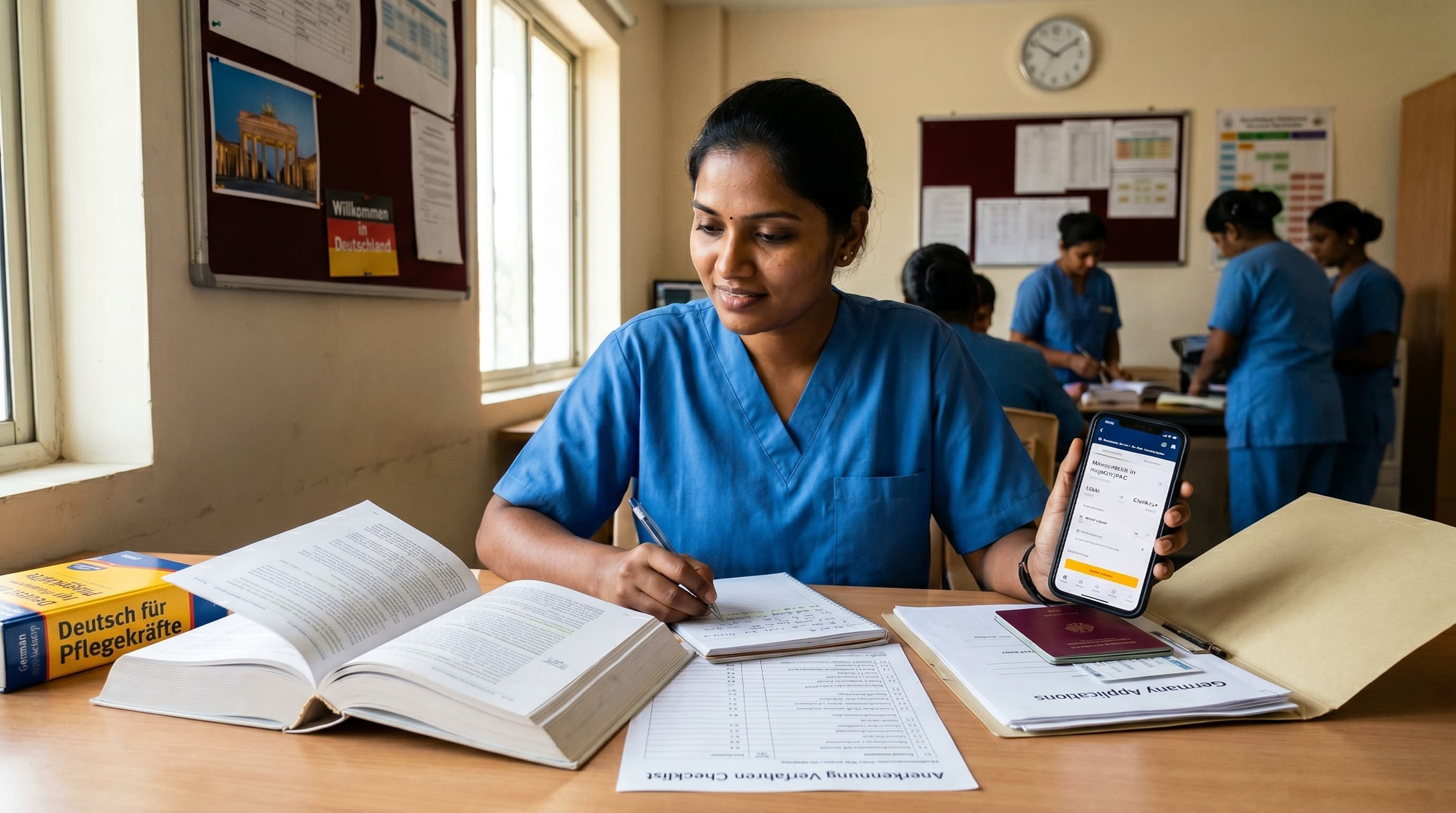
Anerkennung means "recognition" in German. For nurses, it's the formal process by which a German state authority (Landesbehörde) compares your Indian nursing qualification against the German nursing standard and determines whether they're equivalent.
It is not a test. It is not an exam. It is a document-based assessment.
The authority reviews your degree, your transcripts, your clinical hours, and your work experience — and then issues one of two outcomes:
- ✦Full recognition (Vollständige Anerkennung): Your qualification is deemed equivalent to the German standard. You can register as a nurse and start working immediately.
- ✦Partial recognition (Teilanerkennung): Your qualification is close but not fully equivalent — usually because of differences in curriculum hours or clinical subjects. You'll need to complete a compensatory measure before full registration is granted.
Most Indian B.Sc Nursing holders receive full recognition. GNM holders more commonly receive partial recognition, though this varies by state authority. Neither outcome blocks your path to Germany — partial recognition just adds a step.
Q: What is the difference between Anerkennung and the APS certificate? A: They're separate processes. The APS (Akademische Prüfstelle) certificate is an academic verification document required specifically for Indian university graduates applying to Germany — it confirms your degree documents are genuine. You submit the APS certificate as part of your Anerkennung application. APS takes 4–8 weeks, so apply for it early. Taldo coordinates both processes simultaneously to avoid delays.
What Happens With Partial Recognition
This is the part no article explains properly — and it's the part that matters most for GNM holders.
Partial recognition means the state authority found gaps between your Indian curriculum and the German nursing standard. To bridge those gaps, you complete an Anpassungsmaßnahme — an adaptation measure. This is either:
- ✦A knowledge test (Kenntnisprüfung): A written and practical exam covering the areas where your curriculum didn't fully meet German standards
- ✦A supervised practice period (Anpassungslehrgang): A period of clinical practice in a German hospital under supervision, usually 3–6 months
The key thing to understand: during the adaptation period, you are typically employed and earning a salary. It's not unpaid training — it's supervised clinical work with a wage. Taldo's hospital partners are experienced with adaptation placements and structure them so candidates can complete the requirement efficiently.
Q: How do I know in advance whether I'll get full or partial recognition? A: You can't know for certain until the state authority issues its decision — but you can make an informed estimate. The main variables are your degree type (B.Sc vs GNM), your clinical hours logged, and which German state your employer is in (each state has slightly different standards). Taldo runs a credential pre-assessment in the first weeks of onboarding and gives candidates a realistic expectation before they commit to the process.
Documents Required for Anerkennung
This is what you actually need to submit. Missing even one of these causes delays.
| Document | Requirement | Notes |
|---|---|---|
| Nursing degree certificate | Original + certified German translation | Must be a sworn translator (vereidigter Übersetzer) |
| All academic transcripts | Original + certified German translation | Every semester, not just final year |
| APS certificate | Original | Apply at least 8 weeks before you need it |
| State/Central Nursing Council registration | Current and valid | Renewal if expired |
| Work experience letters | Original + translation | From all clinical employers |
| CV in German format (Lebenslauf) | German format only | Tabular, photo included |
| Curriculum details | From your nursing college | Used to assess clinical hour equivalence |
Taldo coordinates certified translations, document authentication, and submission sequencing. Nothing gets missed and nothing goes to the wrong authority.
The Timeline: Standard vs Fast-Track
| Route | Processing Time | Cost |
|---|---|---|
| Standard Anerkennung | 3–6 months (no fixed deadline) | State-dependent, typically €100–€200 |
| Fast-track (Beschleunigtes Fachkräfteverfahren) | Maximum 2 months target | €411 government fee |
The fast-track procedure is almost always worth using. It legally binds the state authority to a maximum processing timeline and is coordinated with your employer, embassy, and the Foreign Office simultaneously. For most candidates, it compresses what would be a 4–6 month wait into a reliable 2-month window.
Why the Numbers Back This Up
The data on Anerkennung outcomes is genuinely encouraging — provided you go in prepared:
- ✦1% rejection rate in 2024 for foreign qualification recognition in Germany
- ✦Full recognition increases employment probability by 17 percentage points within one year
- ✦25 percentage points within three years — meaning your career trajectory in Germany improves significantly with full vs partial recognition
- ✦45,100 foreign diploma applications were submitted in Germany in 2024 alone — the pipeline is active and the system is functioning
The nurses who get stuck are those who submit incomplete documents or don't know which state authority to apply to. With Taldo's end-to-end placement process, neither is a problem.
Calculate Your Net Income and Savings
Once your Anerkennung is confirmed, your salary as a fully recognised nurse in Germany is significantly higher than in India. Use the Taldo Germany Salary Calculator to see your personalised net monthly take-home — including what you could realistically send home each month.
Ready to Take the First Step?
If you're unsure whether your specific qualification — GNM, B.Sc, Post B.Sc, or M.Sc — will receive full or partial recognition, the fastest answer is a direct conversation. Chat with a Taldo Senior Career Counsellor for free — no commitment, just clarity. Or join a free Taldo webinar where the recognition process is walked through step by step with live Q&A.
Key Facts & Statistics
- ✦In 2024, there were 45,100 applications for foreign diploma assessment in Germany through ZAB. [Source: chatscontrol.com, 2024]
- ✦The rejection rate for foreign qualification recognition in Germany was just 1% in 2024. [Source: talentorbit.de, 2024]
- ✦Full recognition increases the probability of employment by 17 percentage points within one year and 25 percentage points within three years. [Source: talentorbit.de, 2024]
- ✦The fast-track recognition procedure targets a maximum 2-month processing window at a government fee of €411. [Source: TalentOrbit, 2026]
Q: Which German state should my Anerkennung application go to?
Your application goes to the state authority (Landesbehörde) in the German state where your employer is located — not where you currently live or where your Indian nursing college was based. Each state has slightly different processing standards, which is one reason why the employer and placement location matter before you even start the Anerkennung process. Taldo matches candidates with hospital partners and then submits to the correct state authority automatically. Chat with a Taldo counsellor for personalised guidance.
Q: Am I paid during the adaptation period if I receive partial recognition?
Yes — in most cases. The adaptation measure (Anpassungsmaßnahme) is typically completed within a German hospital, and candidates receive a salary during this period. The exact amount depends on your employer and the tariff agreement in place, but it is not unpaid training. Taldo's hospital partners are experienced with adaptation placements and structure them so you're earning from day one. Chat with a Taldo counsellor for personalised guidance.
Q: Can I apply for Anerkennung before I have a job offer?
Technically yes — you can apply for Anerkennung independently. But practically, the application goes to the state authority of your future employer's state. Without a job offer, you don't know which state to apply to, and the fast-track procedure requires employer involvement. Taldo secures the job offer first, then immediately initiates the Anerkennung application with the correct authority — this is the fastest and cleanest sequence. Chat with a Taldo counsellor for personalised guidance.
Q: How long does Anerkennung take if I use the fast-track procedure?
The fast-track procedure (Beschleunigtes Fachkräfteverfahren) legally binds the state authority to a maximum 2-month processing target. Without fast-track, the standard procedure has no fixed deadline and commonly runs 3–6 months. The fast-track costs €411 — a government fee paid directly to the state authority. For most candidates, the time saved makes this the obvious choice. Chat with a Taldo counsellor for personalised guidance.
Anerkennung isn't the obstacle it sounds like. A 1% rejection rate, a fast-track option that caps the wait at 2 months, and a clear path even if the outcome is partial — the process is more navigable than most candidates expect. The part that makes the difference is preparation: right documents, right authority, right sequence. That's exactly what the team at Taldo is built to handle.