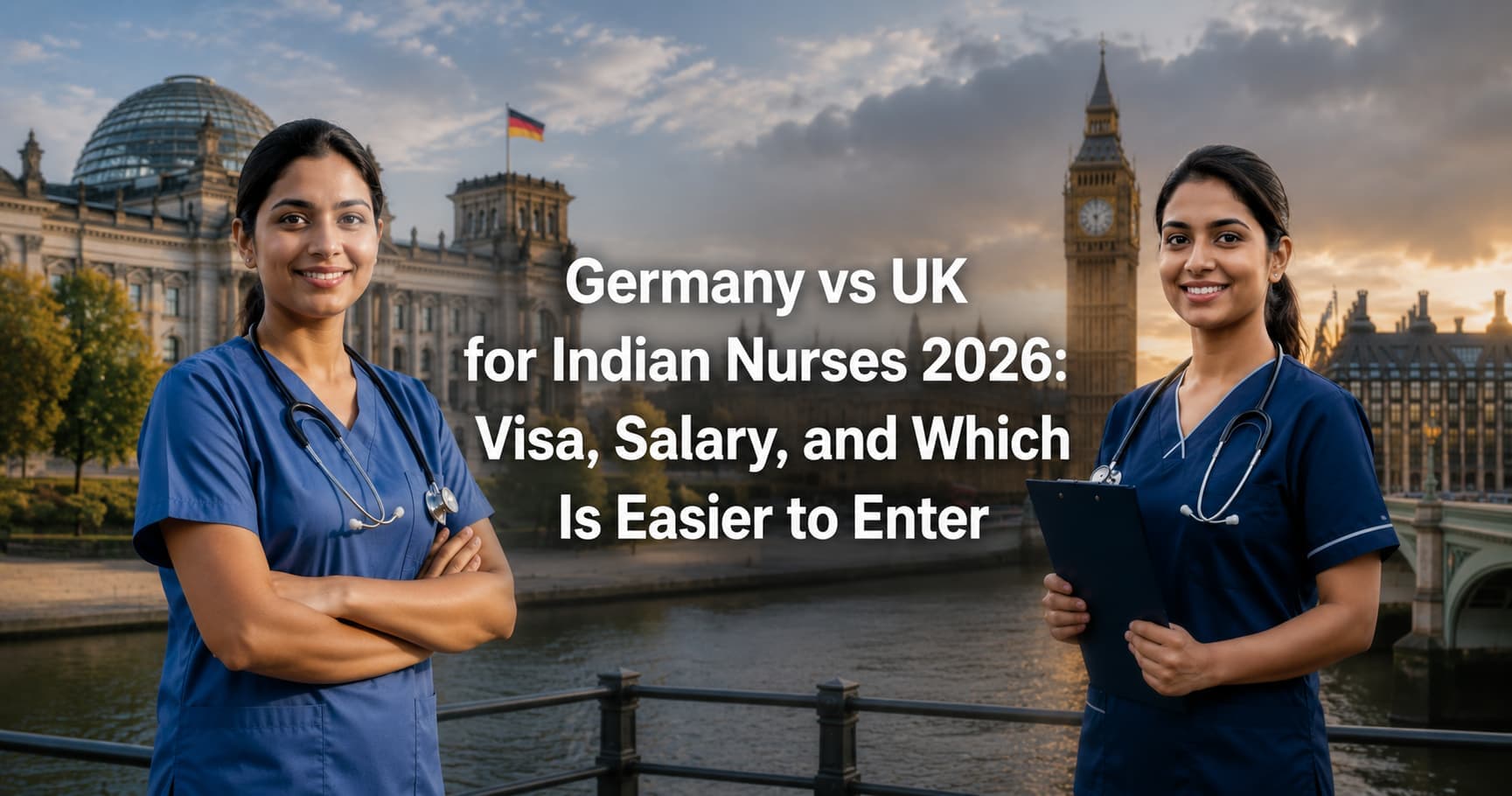
Germany vs UK for Indian Nurses 2026: Visa, Salary, and Which Is Easier to Enter
Fast Facts: Life in Germany
30 Days
Paid Annual Leave
14 Mo
Paid Parental Leave
"Two countries, both actively recruiting Indian nurses, both offering salaries far beyond what you earn in India. The question is not which one sounds better in a headline. It is which one fits your timeline, your language skills, and your long-term plan. This is the honest comparison.
Quick Answer
The Germany vs UK decision for Indian nurses comes down to one core trade-off: speed versus salary. The UK gets you working faster. Germany pays more and costs less to live. This guide breaks down both sides honestly so you can make the decision based on your own circumstances.
Which Country Is Easier for Indian Nurses to Enter?
This is where the UK has a genuine advantage that should be stated plainly.
UK entry for Indian nurses
The UK Skilled Worker Visa for nurses requires:
- ✦IELTS Academic 7.0 overall (no band below 7.0) or OET B in all four categories
- ✦NMC (Nursing and Midwifery Council) registration, which involves passing the Computer-Based Test (CBT) in India and the Observed Structured Clinical Examination (OSCE) in the UK
- ✦A job offer from an NHS trust or approved independent provider with a Certificate of Sponsorship
Most Indian BSc and GNM nurses qualify for NMC eligibility. The CBT can be sat in India; the OSCE takes place in the UK after you arrive on a temporary NMC registration. IELTS 7.0 preparation is achievable for most Indian nurses within 3 to 6 months. The overall timeline from decision to working in a UK hospital is typically 8 to 12 months.
Germany entry for Indian nurses
The German Skilled Worker Visa for nurses requires:
- ✦B2 German language proficiency — a genuinely demanding language level that takes 12 to 15 months to reach from zero
- ✦Anerkennung (recognition) of your nursing qualification by the German state authority
- ✦A signed job contract from a German hospital employer
- ✦Visa processing time of 6 to 10 weeks
The German total timeline is 15 to 20 months. The language requirement is the primary reason — there is no shortcut to B2.
| Germany | United Kingdom | |
|---|---|---|
| Language requirement | B2 German (12 to 15 months from zero) | IELTS 7.0 or OET B (3 to 6 months) |
| Qualification process | Anerkennung + possible bridging course | NMC CBT exam + OSCE exam |
| Visa type | Skilled Worker Visa | Skilled Worker Visa |
| Visa processing | 6 to 10 weeks | 3 to 8 weeks |
| Typical time to first shift | 15 to 20 months | 8 to 12 months |
If you want to start working abroad within a year, the UK is significantly easier to enter. If you are willing to invest 12 to 15 months in German language study, Germany becomes accessible and the long-term returns are higher.
How Do Salaries Compare?
Germany: Registered nurses earn €2,800 to €3,800 gross per month depending on location, seniority, and employer. After German taxes and social contributions (roughly 35 to 40%), the net take-home is €1,700 to €1,900 per month — ₹1,53,000 to ₹1,71,000 at today's exchange rates. For a full city-by-city breakdown in Indian rupees, read our guide to German nursing salaries in Indian rupees.
UK: NHS nurses start at Band 5, earning £28,407 to £34,581 per year (£2,367 to £2,881 per month gross). After UK income tax and National Insurance, net take-home on a Band 5 salary is approximately £1,950 to £2,300 per month. Band 6 (£35,392 to £42,618/year) is achievable with experience but is vacancy and performance dependent.
| Germany | United Kingdom (NHS) | |
|---|---|---|
| Gross monthly | €2,800 to €3,800 | £2,367 to £2,881 (Band 5) |
| Net monthly | €1,700 to €1,900 | £1,950 to £2,300 |
| Rent, 1-bed outside capital | €500 to €900 | £700 to £1,200 |
| Family healthcare | Statutory, included | NHS surcharge applies for dependants |
| Pension | State pension contributions | NHS pension scheme |
On raw net figures, the UK and Germany are closer than most people expect. The difference is in cost of living: German housing outside Munich and Frankfurt is significantly cheaper than UK equivalents, and German healthcare coverage is statutory and includes family members with no additional charge. The actual monthly savings rate for Indian nurses in Germany is typically higher than in the UK.
Permanent Residency: How They Compare
Both countries offer Permanent Residency after 5 years of legal residence.
Germany: After 5 years (or as early as 3 years under the 2023 Skilled Immigration Act reform for eligible skilled workers), you can apply for the Niederlassungserlaubnis. Once granted, your right to remain is independent of your employer. German citizenship is available after a further 3 to 5 years, and Germany permits dual nationality under the 2024 citizenship reform.
UK: After 5 years on a Skilled Worker Visa, you can apply for Indefinite Leave to Remain (ILR). You must pass the Life in the UK test and meet a continuous residence requirement. British citizenship is available after a further year. The UK does not permit dual nationality with most countries.
Both pathways are real and achievable. Germany's post-2023 reform makes an accelerated 3-year route possible for qualifying skilled workers, and Germany is more permissive on dual citizenship.
Which Is the Right Choice for You?
Choose the UK if:
- ✦You want to start working abroad within 8 to 12 months
- ✦You are not ready to commit to 12 to 15 months of German language study
- ✦You have existing community or family connections in the UK
- ✦You are early in your career and want NHS clinical exposure first
Choose Germany if:
- ✦You are willing to invest in language study for stronger long-term returns
- ✦You want a higher net salary and a lower cost of living
- ✦You are planning to settle permanently and want a PR pathway independent of your employer
- ✦You want healthcare and pension contributions guaranteed by law from day one
For a similar comparison of Germany against another popular destination, read our Germany vs Canada guide for Indian nurses.
Q: Can I work in the UK first and then move to Germany later?
Yes. Some Indian nurses use the UK as a stepping stone — building international clinical experience and savings while studying German on the side. UK clinical experience is considered during the German Anerkennung process and can shorten the Anpassungslehrgang if you receive partial recognition. If you plan to eventually move to Germany, starting German language study while working in the UK is the most effective use of your time there.Q: Does Germany have an exam equivalent to the UK OSCE?
Germany does not have a single standardised clinical exam. The Anerkennung process assesses your qualification documents rather than your clinical skills directly. If you receive partial recognition (common for GNM nurses), you complete an Anpassungslehrgang (adaptation course) in a German hospital. Some states offer a Kenntnisprüfung (knowledge exam) as an alternative to the adaptation course, but it is less commonly chosen. For BSc nurses who receive full recognition, there is no exam at all.Q: Is the cost of living in Germany really lower than the UK?
Outside major cities, yes — significantly. Monthly rent for a one-bedroom flat in cities like Dortmund, Nuremberg, or Leipzig is €500 to €750. The equivalent in comparable UK cities like Birmingham or Leeds is £800 to £1,100. Grocery and transport costs in Germany are also lower on average. Munich and Frankfurt are exceptions and their housing costs approach London levels. Most nurses placed through Taldo are matched with hospitals in mid-sized German cities where the savings rate is highest .If you want an honest assessment of which country fits your qualification, language level, and timeline, chat with a Taldo Senior Career Counsellor on WhatsApp — it is free and specific to your situation.