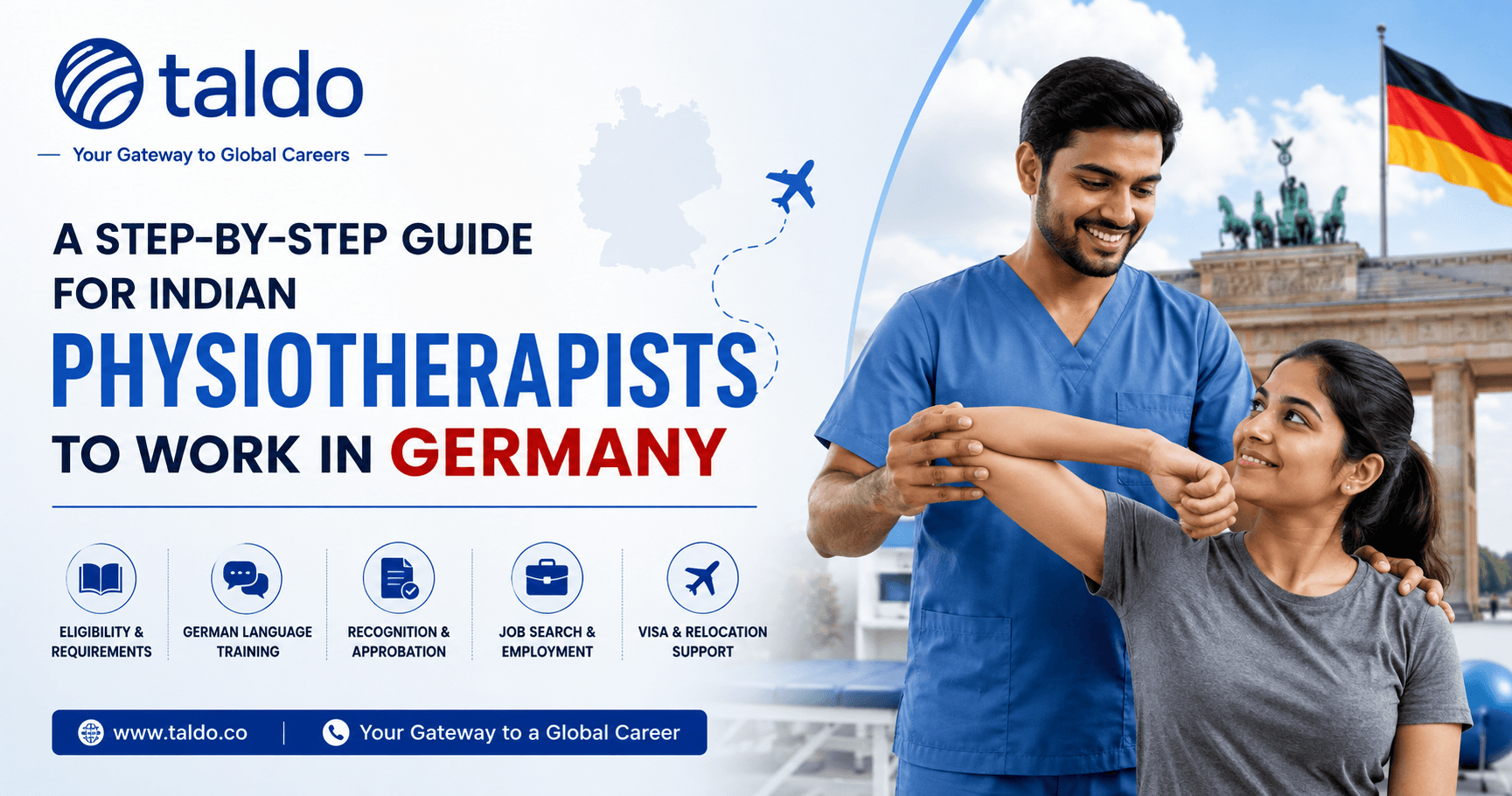
How to Work as a Physiotherapist in Germany from India: Step-by-Step Guide 2026
Fast Facts: Life in Germany
5 Years
To German Citizenship
€3,200+
Starting Monthly Pay
"You're probably wondering what it actually takes to work as a physiotherapist in Germany. The demand is real, the salaries are significantly higher than in India, and the path — while structured — is navigable with the right preparation.
Quick Answer
Germany has a growing shortage of qualified healthcare professionals, and physiotherapists are increasingly part of that gap. For Indian PTs with the right preparation, this translates into a concrete path — not just higher pay, but a stable long-term career in a well-funded healthcare system.
The process involves three parallel tracks: language training, qualification recognition, and visa. Here's how each works.
Step 1 — Get Your Qualifications Recognised (Berufsanerkennung)
Before you can work as a physiotherapist in Germany, your Indian qualification must be formally recognised by the relevant state authority. This process is called Berufsanerkennung (professional recognition) and is mandatory regardless of your experience level.
| Stage | What Happens | Typical Timeline |
|---|---|---|
| Document submission | Submit degree, transcripts, council registration | 1–2 weeks to prepare |
| Authority review | State assesses equivalency of your qualification | 2–6 months |
| Recognition certificate | Issued upon approval — required to apply for jobs | 1–2 weeks after decision |
If your qualification is assessed as partially equivalent, you may need to complete a compensation measure (an adaptation course or knowledge test) before full recognition is granted.
Step 2 — Reach B2 German
German language proficiency is non-negotiable for clinical work. Most hospitals and rehabilitation centres require B2. Some employers accept B1 with an agreed timeline to reach B2 during a probationary period, but this is the exception rather than the rule.
Learning German from scratch to B2 typically takes 8–12 months of structured study. The language levels work like this:
| Level | What You Can Do |
|---|---|
| A1–A2 | Basic greetings, simple phrases |
| B1 | Everyday conversation, functional communication |
| B2 | Professional-level fluency — required for clinical roles |
Medical German (ward conversations, patient communication, documentation vocabulary) is a separate layer on top of B2 and something employers will expect from day one. See our A1 to B2 language guide for healthcare professionals for what this journey looks like in practice.
Step 3 — Secure Your Visa
Indian physiotherapists typically apply for one of two visa types:
- ✦Skilled Worker Visa (Fachkräfte-Visum): For most PTs entering Germany with a recognised qualification and a job offer
- ✦EU Blue Card: Available if your annual salary meets the minimum threshold (€48,300/year for physiotherapists)
Visa processing takes 3–4 months from application. You'll need your Berufsanerkennung certificate, a job contract, and proof of B2 language proficiency as part of the application.
What Does the Full Timeline Look Like?
Running all three tracks in parallel is the most efficient approach:
| Phase | Duration |
|---|---|
| Language training (A1–B2) | Months 1–10 |
| Document collection + Berufsanerkennung | Months 4–10 |
| Job search + offer | Months 8–12 |
| Visa application + processing | Months 12–16 |
| Arrival in Germany | Month 16–20 |
Most Indian PTs who start language training immediately can expect to be working in Germany within 16–20 months. For a broader look at how this timeline compares across healthcare roles, see how long it actually takes to move to Germany.
Calculate Your Net Income and Savings
Use the Taldo Germany Salary Calculator to estimate your take-home pay based on your expected gross salary, tax class, and deductions — alongside a direct comparison to your current Indian salary.
Ready to Take the First Step?
Chat with a Taldo Senior Career Counsellor for free. They'll assess your specific qualifications, advise on which state authority handles your recognition, and help you build a realistic timeline.
Q: Do I need B1 or B2 German to work as a physiotherapist in Germany?
B2 is the standard requirement for clinical physiotherapy roles in Germany. A minority of employers accept B1 with a written commitment to reach B2 within 6 months of starting — but these positions are harder to find and may come with a lower starting salary. Plan for B2 from the beginning to give yourself the widest range of job options. Chat with a Taldo counsellor for guidance on language training options.
Q: What types of physiotherapy jobs are available in Germany?
Indian PTs typically find roles in hospitals (acute care, post-surgical rehab), inpatient rehabilitation centres, outpatient physiotherapy clinics, and long-term care facilities. Hospital roles tend to offer the most structured onboarding and the clearest path to permanent residency. Private clinics may offer higher pay but less job security in the early stages. Chat with a Taldo counsellor to understand which setting fits your background.
Q: How long does the Berufsanerkennung process take for Indian physiotherapists?
The recognition process typically takes 2–6 months from document submission to decision. The exact timeline depends on which German state you apply to, how complete your documentation is, and whether your qualification is assessed as fully or partially equivalent. Starting the process as early as possible — ideally while you're still in language training — prevents it from becoming a bottleneck later. Chat with a Taldo counsellor for help with document preparation.