Partial Recognition of Your BPT in Germany: Adaptation Period vs Knowledge Exam
Fast Facts: Life in Germany
38-40
Hrs / Week Work
5 Years
To Permanent Residency
"Opening the recognition letter and seeing "partial" instead of "full" feels like a setback. It isn't a rejection. It's the German authority telling you exactly what stands between your BPT and a licence to practise, and giving you two routes to close the gap.
Many Indian physiotherapists assume recognition is a yes-or-no decision. In practice, there is a third outcome, and it is the most common one for Indian applicants: your qualification is found to be partly equivalent, and you are asked to complete a compensation measure before you receive full recognition.
This guide explains what partial recognition means, how the adaptation period and the knowledge exam differ, how to choose between them, and what to do to avoid being stuck in the process longer than necessary.
What Partial Recognition Actually Means
When you apply for recognition, the authority compares your BPT with the German physiotherapy training, which is a three-year programme combining theory, practical skills and supervised clinical work. They look at subjects, hours and the practical experience built into your training.
There are three possible outcomes:
| Outcome | What it means | What happens next |
|---|---|---|
| Full recognition | Your BPT is considered equivalent | You can apply for your licence to practise |
| Partial recognition | Substantial differences were found | You must complete a compensation measure |
| Rejection | Equivalence cannot be established | You may need to consider other routes or an appeal |
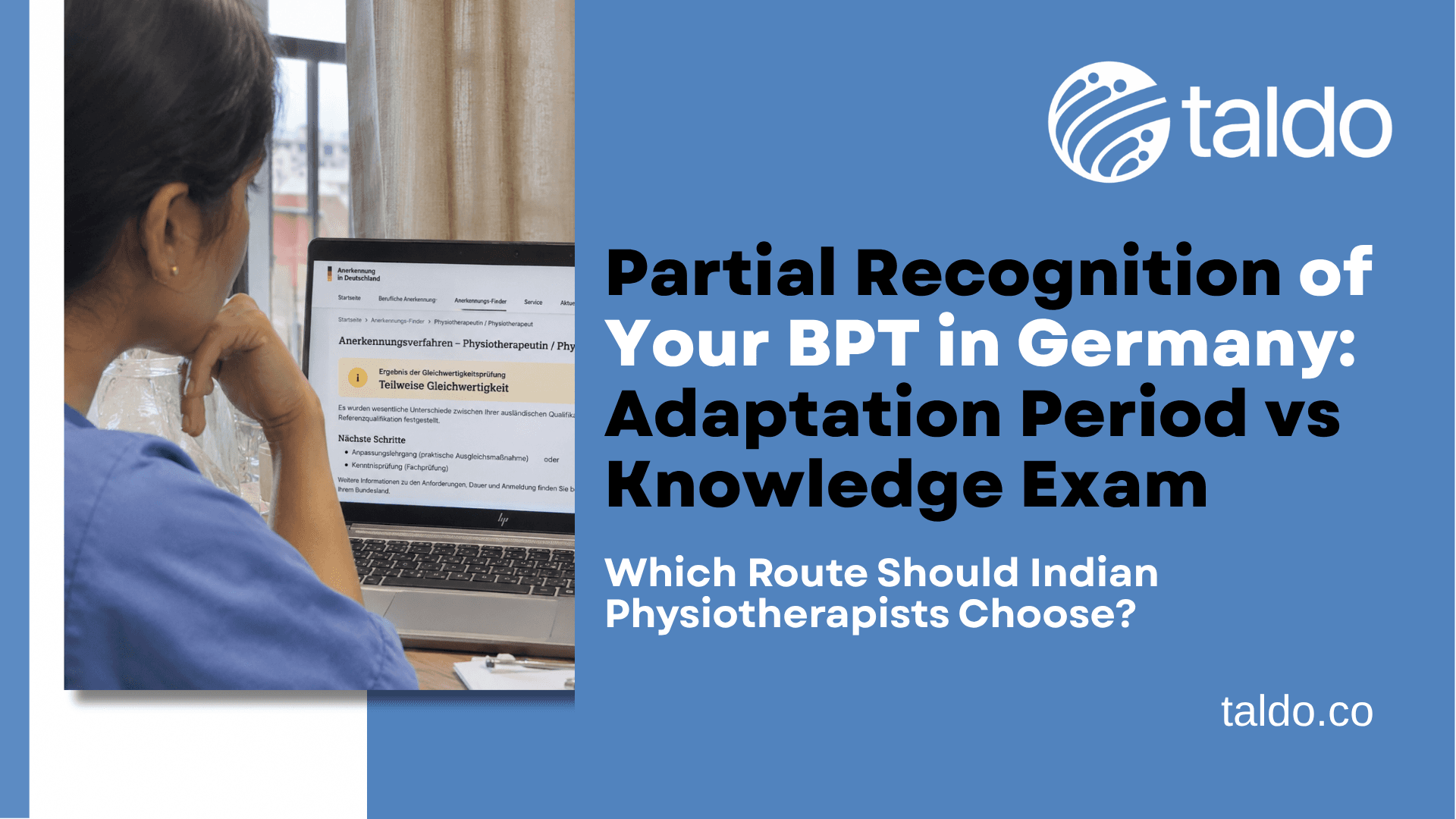
Partial recognition comes with a written decision that lists the specific differences found. This document is important. It tells you which subjects or practical areas are considered lacking, and it is the basis for everything that follows. If you want a clearer picture of how those gaps are identified in the first place, our guide to what determines how a BPT is evaluated for physiotherapy practice in Germany walks through the factors behind the decision.
The Two Routes: Adaptation Period or Knowledge Exam
After a partial decision, you generally choose between two compensation measures. Depending on your state and authority, the choice may be yours or may be guided by the authority, so confirm this early.
| Factor | Adaptation period (Anpassungslehrgang) | Knowledge exam (Kenntnisprüfung) |
|---|---|---|
| Format | Supervised practical work in a German facility | Examination before an examination board |
| Focus | The areas listed as deficient in your decision | Content of the German final physiotherapy examination |
| Duration | Set by the authority, depending on the gaps | A single exam date after preparation |
| Preparation | Learning on the job with supervision | Self-study, courses and mock exams |
| Ends with | Confirmation of successful completion | Passing result |
| Typical risk | Finding a placement; slower to start | Failing and needing to retake |
Neither route is automatically easier. The right choice depends on your gaps, your confidence in German, and whether you can secure a placement.
Route 1: The Adaptation Period
The adaptation period (Anpassungslehrgang) is a supervised period of practical work in a German healthcare setting, such as a rehabilitation clinic, hospital or physiotherapy practice. Its length and content are set by the authority based on the specific differences it found. A smaller gap generally means a shorter period.
Why people choose it
- ✦You learn directly in a German clinical environment, which builds both skills and professional language.
- ✦You usually work while you complete it, which means a structured start to your German career.
- ✦There is no single high-stakes exam day, although you are assessed during and at the end of the period.
What to watch for
- ✦You need an employer or training site willing to host and supervise you. Not every clinic offers this.
- ✦Your pay and responsibilities during this phase differ from those of a fully recognised physiotherapist, so check the terms in writing.
- ✦The supervising team must confirm that you completed the programme, so the quality of your placement matters.
Route 2: The Knowledge Exam
The knowledge exam (Kenntnisprüfung) tests whether you have the knowledge of a German-trained physiotherapist. It follows the structure of the final examination in German physiotherapy training and typically includes theoretical questions and practical demonstrations, often with a patient-based element. Your decision letter and the examination authority will confirm what to expect.
Why people choose it
- ✦It can be faster if you are well prepared, since there is a fixed date rather than a fixed training duration.
- ✦You are not dependent on finding a host clinic before you start.
- ✦A pass settles your recognition in one step.
What to watch for
- ✦You must be ready to explain clinical reasoning, assessments and treatment planning in German, under examination conditions.
- ✦Failing means retaking the exam, which costs time and money, and many authorities limit how many attempts you get.
- ✦Preparation requires structure: lectures, practical rehearsal and mock sessions, not just reading.
How to Choose Between the Two
A simple way to decide is to look at three things honestly.
1. How large are your gaps? If the decision lists a few specific areas, a targeted adaptation period may be a natural fit. If the gaps are broad across several subject areas, the knowledge exam may be a better way to demonstrate your overall competence, provided you are ready for it.
2. How strong is your German? The knowledge exam is demanding in a spoken and written way. Your language level shapes how much you can show of what you know. Most professional practice assumes B2, and if you are still deciding how to sequence your language preparation, our comparison of German B1 versus B2 requirements for Indian physiotherapists explains where each level fits.
3. Can you secure a placement? An adaptation period depends on a host. If you already have an employer who will supervise you, that route becomes far more practical. If not, the exam may be the more independent path.
What Happens to Your Pay and Timeline
Until you receive full recognition, your role and earnings are typically different from those of a recognised physiotherapist. After recognition, a physiotherapist in Germany can expect around €3,400–€3,600 gross per month, which is roughly €2,300–€2,600 net. Many people see the compensation phase as an investment period: the sooner you complete it, the sooner you reach those figures.
Timelines vary by state, authority and individual case, so plan with flexibility rather than a fixed date. Delays most often come from incomplete documents, slow appointment scheduling and difficulty finding a placement or exam slot.
Practical Steps After You Receive Partial Recognition
- ✦Read the decision carefully. Note every listed difference and any deadlines for choosing a measure.
- ✦Confirm your options with the authority. Ask whether you can choose between the two routes, and what each involves in your state.
- ✦Map the gaps to your own strengths. Be honest about which topics need real study.
- ✦Plan your language preparation. Clinical German is what the exam and the supervised placement both demand.
- ✦Line up a placement or exam preparation. Do this in parallel with the authority process, not after it.
- ✦Keep your paperwork organised. Missing documents are a common cause of delay at every stage.
Is Partial Recognition a Bad Sign?
No. For many applicants from India, partial recognition is simply the result of a different training structure rather than a lack of competence. Hours of practical training, subject division and curriculum design differ between the two systems. The compensation measure is the formal way of bridging that structural difference.
The physiotherapists who handle this stage best are the ones who treat it as a project: they understand the decision, pick the route that suits their strengths, and prepare early.
Getting Support With the Process
If you have received a partial decision, or you are preparing your application and want to understand your likely outcome, it helps to talk it through with people who work with German employers and recognition cases regularly. Taldo guides Indian physiotherapists through language preparation, recognition and placement. You can message the Taldo team on WhatsApp to discuss your own situation.
Q: What does partial recognition of my BPT mean?
It means the German authority found substantial differences between your BPT and German physiotherapy training. You are not rejected. You must complete a compensation measure, either an adaptation period or a knowledge exam, before you can receive full recognition and a licence to practise.
Q: Which is better: the adaptation period or the knowledge exam?
Neither is better for everyone. The adaptation period suits people with a few specific gaps and access to a host clinic, while the knowledge exam suits those who are confident in German and can prepare thoroughly. Your decision letter and local authority will confirm which options apply to you.
Q: Can I work as a physiotherapist in Germany while completing the compensation measure?
In many cases you can work in a supervised role during an adaptation period, but the exact permissions, duties and pay depend on your state and your employer. Full independent practice and the standard recognised salary come after you receive full recognition, so confirm the terms in writing before you start.