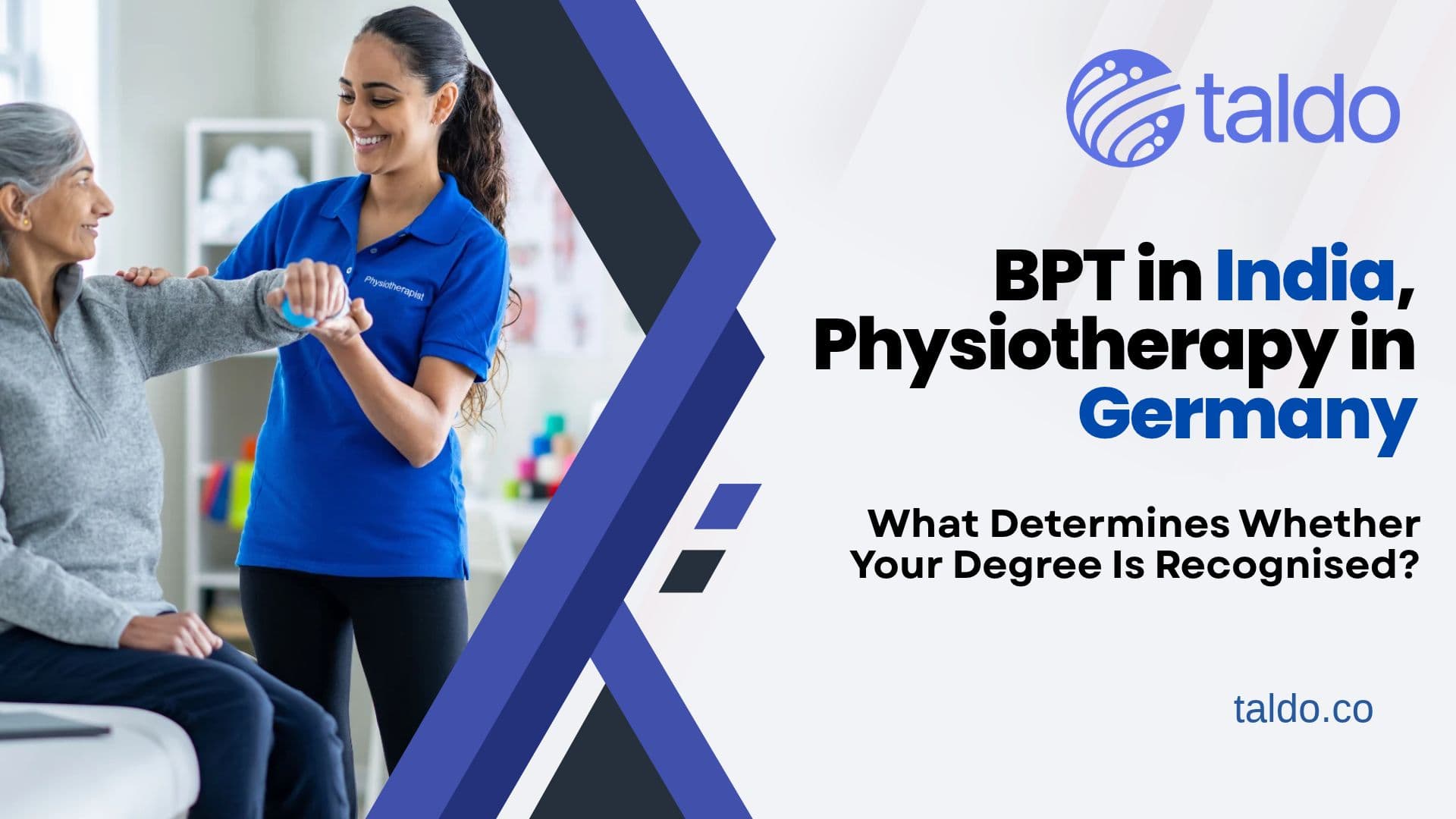
BPT in India, Physiotherapy in Germany: What Determines Whether Your Degree Is Recognised?
Fast Facts: Life in Germany
5 Years
To Permanent Residency
€3,200+
Starting Monthly Pay
"Your BPT took years of hard work, but in Germany the question is not whether your degree is respected. It is whether your training matches the German physiotherapy qualification closely enough to be recognised.
Every year, more Indian physiotherapists look at Germany as a place to build a stable, well-paid career. Demand for physiotherapists in German clinics, rehabilitation centres and hospitals keeps growing, and employers are increasingly open to international talent. But before you can work under the protected title "Physiotherapeut/in", your qualification has to go through a formal recognition process called Anerkennung.
This guide explains what German authorities actually look at, what outcomes you can expect, and how to prepare so the process goes smoothly.
Why Recognition Matters
Physiotherapy is a regulated healthcare profession in Germany. You cannot simply start work as a physiotherapist on the strength of a foreign degree. The state authority responsible for your intended place of work must confirm that your training is equivalent to the German qualification. Until that happens, you cannot practise independently or be employed in the full role.
Once recognition is complete, a physiotherapist can expect a gross salary of €3,400–€3,600 per month, which translates to roughly €2,300–€2,600 net depending on tax class and location.
How Germany Trains Physiotherapists
To understand how your BPT is assessed, it helps to know what it is compared against. German physiotherapists usually train through a three-year vocational programme at a specialised school, combining classroom theory with a large amount of supervised practical work in clinics.
The Indian BPT is a university degree of around four and a half years, including a compulsory internship. On paper that looks longer, but the authorities do not compare duration alone. They compare content, depth and practical exposure.
| Aspect | BPT (India) | German Physiotherapy Training |
|---|---|---|
| Typical duration | ~4.5 years including internship | ~3 years |
| Type of programme | University degree | Vocational school programme |
| Practical component | Clinical postings and internship | Extensive supervised clinical practice |
| Strong focus areas | Musculoskeletal, neuro, cardio-respiratory, sports | Manual therapy, exercise therapy, massage, physical agents, medical training therapy |
| Regulated title | Physiotherapist (varies by state council) | Physiotherapeut/in (protected title) |
What Determines Whether Your Degree Is Recognised
The authority carries out what is called a Gleichwertigkeitsprüfung, an equivalence check. Several factors decide the outcome.
1. Content of your curriculum. Your subjects, hours and practical modules are compared with the German curriculum. Areas such as massage therapy, physical agents like electrotherapy and hydrotherapy, and manual lymphatic drainage are often examined closely, because Indian curricula may cover them in less detail.
2. Hours of practical training. German training places heavy weight on supervised hands-on work. Your internship and clinical posting records need to show enough hours across different specialities.
3. Quality of your documents. Incomplete transcripts, missing syllabus details or unclear internship certificates are among the most common reasons for delays and for being asked to prove more.
4. Professional experience. Relevant work experience as a physiotherapist can sometimes help offset gaps in formal training, provided it is well documented.
5. Language level. You generally need German at B2 level for professional practice. Some states additionally require a medical language test, which is more demanding than a general B2 exam.
The Three Possible Outcomes
After reviewing your file, the authority issues one of three decisions.
| Outcome | What it means | What you do next |
|---|---|---|
| Full equivalence | Your training matches the German standard | You receive your licence to practise once language and other requirements are met |
| Substantial differences | Gaps exist between your training and the German one | You choose between an adaptation course and a knowledge exam |
| No equivalence | Training cannot be matched | You may need to retrain or take a different route, such as a vocational pathway |
Most Indian applicants fall into the middle category. That is not a rejection. It simply means you complete a defined compensation step, either an Anpassungslehrgang (adaptation period of supervised practice) or a Kenntnisprüfung (knowledge exam covering the areas of difference).
Documents You Will Typically Need
Preparing early saves months. Applications usually ask for:
- ✦Passport and CV in German format
- ✦BPT degree certificate and mark sheets
- ✦Detailed syllabus and subject hours
- ✦Internship completion certificate
- ✦Registration with your state physiotherapy council, where applicable
- ✦Work experience letters with duties described
- ✦Proof of German language level
- ✦Certified German translations of key documents
Documents generally need to be translated by a sworn translator and, in many cases, officially certified. Requirements differ from state to state, so check what the authority in your target region asks for before you submit.
Timelines and Costs to Plan For
Recognition is not instant. Processing commonly takes several months, and delays happen when files are incomplete. Language learning from A1 to B2 usually takes the longest and runs alongside the paperwork. If you want a realistic view of the full journey, our guide on how long it actually takes to move to Germany breaks down each stage. Although it is written with nurses in mind, the sequence of language, recognition and visa is very similar for physiotherapists.
Budget for translation, certification, exam and authority fees, plus language courses. The exact amounts vary by state and provider, so treat any early estimate as a rough guide.
How to Improve Your Chances
- ✦Start with your syllabus. Collect a detailed subject-wise syllabus with hours from your university early. It is often the hardest document to obtain.
- ✦Document every internship rotation. Dates, departments and hours matter.
- ✦Learn German while the file is processed. Do not wait for the decision to start language classes.
- ✦Pick your target state carefully. Authorities differ in processing speed and in how they handle gaps, so the region you apply in affects your timeline.
- ✦Get your paperwork reviewed before submission. A clean, complete file is the best way to avoid back-and-forth requests.
For a deeper look at how the process works in practice, read our overview of what Indian healthcare professionals need to know about Anerkennung. The logic behind document checks and equivalence decisions applies across regulated health professions.
The Bottom Line
A BPT is a solid foundation for a physiotherapy career in Germany, but recognition depends on how closely your curriculum, practical hours and documents match the German standard. Most applicants are asked to close small gaps rather than start over, and with early preparation, the process is very manageable.
If you are a BPT graduate considering Germany and want clear, honest guidance on your options, chat with the Taldo team on WhatsApp and we will help you understand where you stand.
Q: Will my BPT be recognised in Germany, and what if there are gaps?
Recognition depends on how closely your curriculum, practical hours and documents match the German qualification. Full recognition is possible, but many Indian applicants receive a decision of substantial differences. That is not a rejection: you complete either an adaptation period of supervised practice or a knowledge exam on the areas of difference, and then receive your licence. A BPT is also not worthless if you are refused equivalence, since other routes, including vocational pathways, may still be open to you.
Q: What German level do I need, and how long does the whole process take?
You generally need B2 German to practise, and some federal states also require a medical language test that checks clinical communication. Recognition itself commonly takes several months, while learning German from A1 to B2 usually takes longest, so it is best to study in parallel with your application. Requirements and processing speed vary by state, so plan for the full journey to take well over a year from start to finish.
Q: How much can I earn, and can I work while my recognition is pending?
After recognition, physiotherapists typically earn a gross salary of €3,400–€3,600 per month, which is roughly €2,300–€2,600 net depending on tax class, employer and region. Until recognition is complete you cannot work in the full physiotherapist role, so employers and authorities usually arrange supervised or assistant-level work during an adaptation period. Confirm the exact rules with the authority in your target state before you plan your finances.